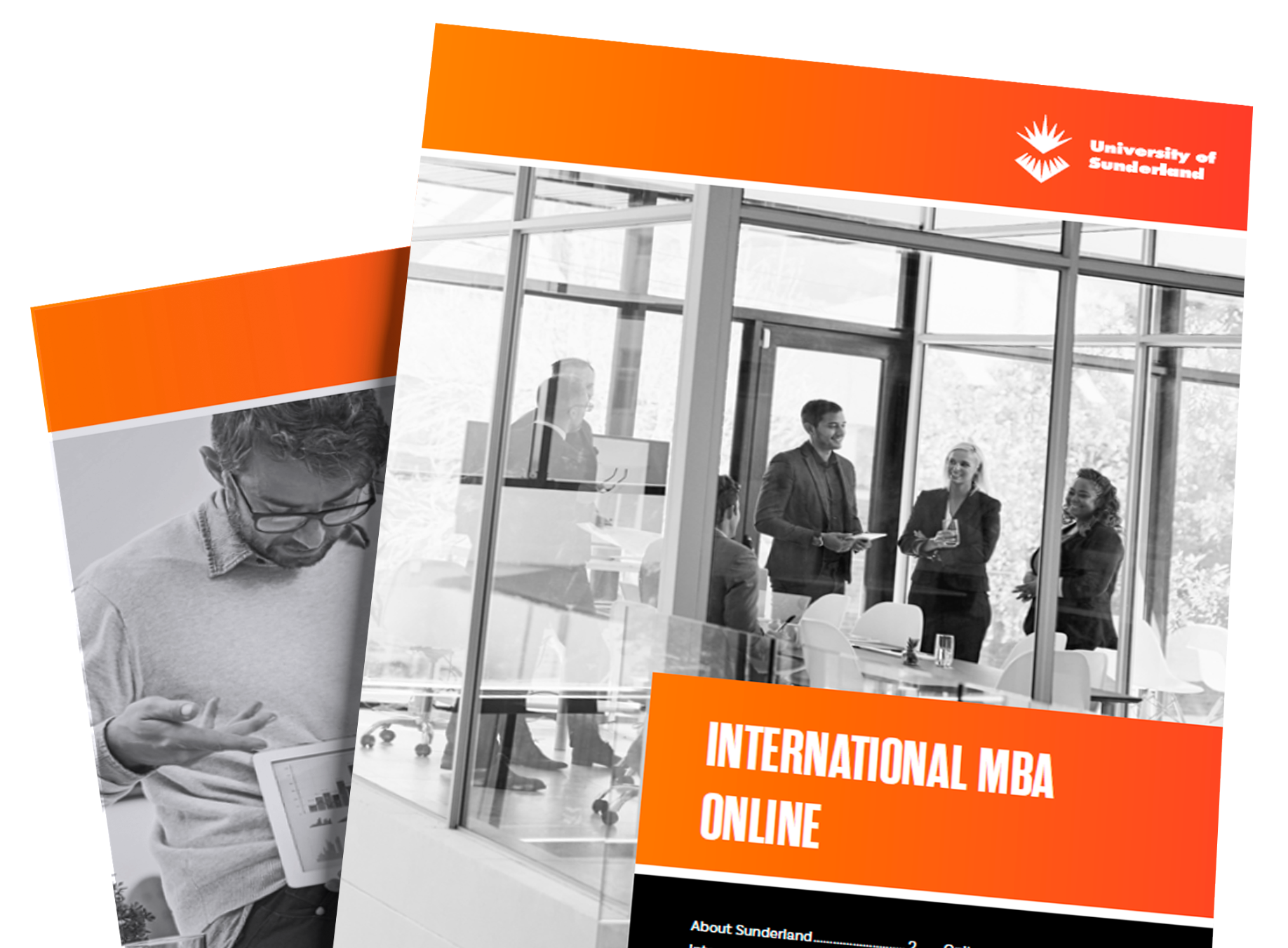

An International MBA to take your career to the next level
The 100% online International MBA from the University of Sunderland has been created for leaders and aspiring leaders from a wide range of industries, sectors and backgrounds who want to step up into more senior positions or who wish to take their career in a new direction entirely. The MBA equips you for strategic, cross-cultural and international roles in organisations where decision-making involves evaluation and analysis of challenging and fast-changing environments and the exploration of opportunities to implement change at a strategic level.
Underpinning this International MBA is the development of enhanced leadership skills, refined through self-reflection on personal performance. The MBA develops your ability to make informed decisions, adopt a critical perspective, communicate ideas and develop cultures that encourage and maximise the wellbeing and productivity of teams and individuals.
What will you study?
The International MBA degree is designed to develop your ability to manage and lead holistically within organisations. You will learn how to effectively integrate cross-functional practices to address business problems, create and capitalise on opportunities and provide solutions in a wide range of international organisational contexts.
The International MBA will help grow your confidence as a leader, deepen your understanding of the dynamic business environment and develop your data analysis, problem solving and innovation skills, equipping you to guide strategic direction.
Key knowledge and skills taught on this course:
Leadership and management across global contexts
International trade
Global corporate strategy
Financial management
Organisational behaviour and cultural change
International marketing
Big data analytics
Operations management
A global University with specialist expertise in online learning
Our work with students from around the globe goes back over 40 years and is reflected in our campus locations in Hong Kong, Sunderland and London and strong international partnerships across the world including in the Caribbean, Greece, Kenya, Malaysia, Lanka, Oman, Singapore, Sri Lanka, Tashkent and Vietnam. We take pride in being a place for diverse learner cohorts who benefit from interactions with each other and are able to grow their global professional networks.
There is a high percentage of international students at University of Sunderland, and we have students studying by distance learning around the world. Sunderland is also one of the UK’s leading widening participation Universities and is 7th in UK for social inclusion (The Times and Sunday Times Good University Guide 2024).
Our experience, our leading-edge technology and our expertise in delivering outstanding online learning experiences to an audience of global students are key to what sets the University of Sunderland and our online International MBA apart.
Admission requirements
At least a UK 2.2 undergraduate degree plus a minimum of two years’ relevant work experience
A UK master’s degree (or international equivalent) plus a minimum of two years’ relevant work experience, in either a managerial or professional capacity
A third-class honours degree or an ordinary degree (without honours) or UK equivalent professional qualification with a minimum of three years’ appropriate work experience
Applicants who do not hold a recognised degree will be asked to provide evidence which demonstrates a minimum of three years’ relevant organisational experience The work experience must be at a graduate level, in either a managerial or professional capacity which may include voluntary work, placements, internships, or project management
Fees Total
£9660
Per 15-credit module
£805
Fees
If you are based in the UK, you may be eligible for a government-backed postgraduate loan to cover the full costs of the course.
In addition, if you have successfully completed an undergraduate degree at the University of Sunderland, you are eligible for a 10% tuition fees reduction on our postgraduate programmes.
You pay tuition fees for each module taken, either module-by-module or in full at the start of your course.
If you pay module-by-module, you will pay in instalments of £805.
Modules
Successful professionals have different approaches to their work, sharing a range of diverse personality traits, attributes and beliefs. These underpin skills proficiency but cannot in themselves be described as ‘skills’. However often they are central determinants of an individual manager’s effectiveness and are developed consciously over time. This module encourages you to develop a strong sense of self-awareness of your own strengths and weaknesses as a manager and a colleague. In addition, it seeks to help you to develop and improve a range of definable skills which are pivotal to successful management practice and to effective leadership in particular.
Walking into a supermarket and finding bananas and coffee from South America, wine from California and New Zealand and cocoa from Nigeria is a result of international trade. This module will provide you with an understanding of how countries expand their markets for both goods and services that otherwise may not have been available domestically. It will explore how international trade leads to greater competition and competitive pricing and how this affects the consumer. You will understand the flow of goods and services across international boundaries from supply and demand factors, economic integration, and policy variables.
This module looks at the systems of internal measures put in place by those responsible for financial management. By managing risk, these measures seek to ensure that financial and other resources are used in regular, ethical, economical and effective ways that are to the benefit of the business and support its objectives. The module examines financial management and control, the system which directs and controls the financial effects of budget user’s operations in a way that ensures that they support business success.
Business is increasingly becoming global. The global view relates not only to an assessment of competitors but also the geographic and demographic arenas in which they function. This module examines key contemporary issues surrounding international and global strategic management. A framework will be established to enable you to understand the strategic management and strategic leadership processes involved in organisations. In this context, strategy can only be analysed and understood when the various stakeholders and their complex relationships are considered as part of the management of multinational enterprises (MNEs). This is achieved by examining the design of strategic management and leadership processes and how strategic decisions affect the functioning of organisations operating in both domestic and international markets.
This module focuses on how leadership and management facilitate organisational, team and individual change and growth. It draws on the established body of both academic knowledge and theory and professional practice in leadership and management development.
The module aims to develop a critical understanding of the complex and much debated nature of leadership and management development in a volatile, uncertain and ambiguous global environment. It covers the development of leadership and management at all levels ranging from first line to senior managers. The module also explores approaches to assessing leadership and management development needs and the design of strategies and programmes within a range of organisations and contexts.
Operations management is the administration of business practices designed to establish the highest level of efficiency within an organisation. You will learn how to focus on the conversion of materials and labour into goods and services as effectively and efficiently as possible in order to maximise profit. You will also gain an understanding of the theory and practice behind the balancing of costs with revenue in order to achieve the highest possible operating profit.
Against a backdrop of new technologies and a proliferation of fast developing marketing channels, effective marketing requires an understanding and ability to design complex solutions that engage effectively with the customer journey. This module explores current marketing theory and how offline and online technologies interact with customers through a myriad of touchpoints. Customers from a range of market perspectives are considered and the application of holistic marketing approaches as a means of supporting ‘needs satisfaction’ and attaining customer loyalty is explored.
Organisational behaviour is the study of human behaviour in organisational settings, exploring the interface between human behaviour and the organisation, and the organisation itself. A variety of factors influence organisational behaviour, including structure, policies, processes and management. You will gain knowledge of how companies can manage and lead change effectively, and by understanding organisational behaviour you will support your personal development and ability to set the standard for accepting, negotiating, and implementing change.
This module develops critical insights into corporate social and environmental responsibility. Corporations have a clear ability to influence and shape the environment, our choices as consumers, the rules of government and the quality of our working lives. In recognition of this power there have been increasing calls for corporate social responsibility at national and international levels. The module examines contemporary themes using case studies to illustrate the complex relationship between business and society and the alternative frameworks through which the subject can be considered. It explores the issues of accountability and regulation and considers alternative forms of organising such as co-operatives and partnerships in order to question whether these structures enable organisations to engage with the broader aims of corporate social and environmental responsibility.
In this module you will investigate techniques that organisations use for performing simple analysis of data for a variety of business applications. You will develop an understanding of the types of data used in business, the differences between structured and unstructured data and how tools can be used to represent and analyse different types of data, including big data, in various contexts.
You will gain an appreciation of how data analytics can enhance business processes, for improved decision making in marketing, customer relationships, sales and forecasting. You will also learn how to apply simple analytical techniques to present information using data visualisation tools.
The purpose of this module is to research, discuss, debate and evaluate innovation and technology transfer. You will develop an understanding of how to develop and implement technology strategy and how to develop the processes, capabilities, networks and culture to incubate, develop and execute innovation strategies. The module explores how to develop business cases and how to create and manage new products and services.
The future success of the national and global economy is largely dependent on a new generation of entrepreneurs and innovators developing new ideas and making them a reality. This module focuses on teaching the skills and knowledge required to successfully set up a business and the skills to drive innovation and change from within an organisation. Entrepreneurial qualities have never been more important or more in demand within existing companies and this module is designed to help you to develop these skills and make yourself a more valuable asset in the employment market.
Top 30 UK University
(Guardian University Ranking 2026)
1st in the North East for teaching quality
(The Times and Sunday Times Good University Guide 2024)
70% of university research rated as ‘world-leading’ or ‘internationally excellent’
(Research Excellence Framework 2021)
8th in UK for social inclusion
(The Times & Sunday Times Good University Guide 2025)
The information below is required for social login
Login to your Account
JOIN FOR FREE
Let’s begin with setting up your account to keep track of your progress